
The reason humanity cannot cure smartphone addiction:

↑That was a normal reaction!
Our mistake lay in treating the brain's innate "habit-forming response" as a disease.
Instead of changing the digital environment, we tried to change the humans themselves.


This was a normal reaction.
These illustrations may look familiar. They may reflect your everyday life.
Take a breath. This is not the image of a broken mind. It is a normal human response.
The basal ganglia help the brain learn rewarding actions and turn repeated behavior into habit.
Becoming unable to easily step away from the smartphone does not begin with a broken brain. It begins with the brain’s normal habit-forming system doing its job.
The real mistake was treating this normal response as a problem within the individual while leaving the digital environment unchanged.
 |  |  |
|---|---|---|
|
The fact that you cannot put down your smartphone is actually proof that your brain is functioning perfectly.
When you unconsciously reach for your phone, a region of your brain called the basal ganglia is taking over. This is an incredibly advanced, energy-saving system that humanity evolved for survival. Its job is to "automate" repeated actions to conserve your brain's energy.
Your brain is not diseased, nor is it broken.
It’s simply that the pleasure chemical (dopamine) released by your screen tricks the basal ganglia into believing, "This action is absolutely critical for survival!" As a result, it has mistakenly constructed a fully automated neural highway specifically for your smartphone habit.
The inability to tear oneself away from a smartphone stems not from a broken mind, but from the brain's normal functioning—specifically, the mechanisms that form habits.
We sought the solution in changing the human psyche while leaving the habit-reinforcing digital environment untouched.
The problem escalated because we tried to fix only the people, without addressing the digital environment itself.

Excessive smartphone use is already a global public health challenge.
In the fields of medicine and public health, a paper titled "Mobile Phone Mania: Arising Global Threat in Public Health" has been published, and excessive reliance on mobile devices is being discussed as a global health concern.

The numbers kept rising while society kept focusing on the individual. The digital environment was left untouched.
As the global smartphone-user population expanded, the modeled number of people experiencing problematic smartphone use also grew dramatically.
A response focused only on the individual leaves unchanged the digital environment that drives repeated engagement.
Source and Methodology:
This chart presents illustrative modeled estimates, not directly observed annual global counts.
The figures were calculated by multiplying estimates of the global smartphone-user population by the pooled prevalence estimate of 26.99% reported in a 2022 meta-analysis.
The same prevalence estimate was applied to 2014, 2019, and 2024. Therefore, the chart primarily illustrates how the estimated number would change as the global smartphone-user population increased.
It should not be interpreted as proof that the prevalence rate itself followed this exact trend.
We are presenting governments and public institutions around the world with a new approach to this global public-health challenge—one that intervenes in the digital environment itself, rather than placing the entire burden on the individual.

We have developed a new digital public health approach that brings about changes in smartphone usage behavior within a short period of 72 hours.
The World-Class Academic Journals Supporting HAKONE’s Scientific Foundation
The theoretical framework for each of HAKONE’s core features—including the 60-second pause, drawing, and affect labeling—is grounded in top-tier neuroscientific literature that has passed rigorous global peer review. The primary academic journals featuring the foundational research for this system include the following:
-
PNAS (Proceedings of the National Academy of Sciences) Published by the National Academy of Sciences, this is one of the world’s most prestigious multidisciplinary scientific journals. Holding an authority rivaled only by Nature and Science, having a paper published in PNAS is considered a profound honor for any researcher (e.g., the study by Kober et al. on the cognitive regulation of craving).
-
Journal of Neuroscience Published by the Society for Neuroscience, this is one of the largest and most trusted top-tier journals in the field of neuroscience globally. It exclusively publishes high-quality brain research that has survived an exceptionally rigorous peer-review process (e.g., studies on frontal-lobe networks by Aron, Jahfari, and colleagues)
-
Nature Neuroscience / Neuron / JAMA These are elite, peer-reviewed journals with extraordinarily high impact factors, widely recognized as ranking among the top three globally in their respective fields of neuroscience and medicine.
72 hours of facts that render existing "mindset-based" approaches a thing of the past.
Behavioral change data resulting from digital interventions—data that could not be obtained through conventional approaches.
A record of "72 hours" proven by the system, not by sheer willpower.

From an average of over 10 hours a day, daily screen time for 100 users plummeted to 7.1 hours in just 72 hours. Continuous use per session was nearly cut in half—dropping from 64.57 to 32.09 minutes. This is the result of simply inserting a 60-second pause on the screen, without confiscating devices or forcing isolation.
Figure Note — Observational Analysis
Paired smartphone-use records from 100 participants (N = 100; ages 18–27) were compared at baseline and at the 72-hour checkpoint. Green dots indicate group means; green horizontal lines indicate medians; boxes represent the interquartile range (25th–75th percentile); whiskers extend to 1.5 × IQR; and diamonds indicate outliers.
Mean daily screen time changed from 10.109 to 7.100 hours (−29.8%), while mean continuous use per session changed from 64.57 to 32.09 minutes (−50.3%).
This was a single-group observational comparison with no control group. The figure describes group-level changes recorded over 72 hours and does not establish causation, clinical effectiveness, diagnosis, treatment, or individual outcomes.
We did not choose the approach of transforming people over the course of several months; instead, we changed the very point of intervention.
We do not attempt to persuade the human mind. Instead, we insert a 60-second pause at the precise moment of interaction, interrupting the automatic loop of repetition directly on the screen. This is a groundbreaking intervention engineered from digital mechanics.
We do not change a perfectly normal brain. We change the digital reinforcement that has relentlessly trained it. In just 72 hours, we establish the gateway to this transformation. This is HAKONE.

Without taking the device away, we intervene in the habit loop directly on the screen, at the exact moment of use. We are introducing a new paradigm to the world—one that breaks entirely free from the traditional tactics of monitoring, blocking, and persuasion.
Because of this, young adults are not stripped of the smartphones that have become an extension of their very bodies. That is exactly why they engage with it so willingly. They jump at the opportunity to try it.
This approach is overwhelmingly welcomed, especially by young adults aged 18 and over.
It is sustainable precisely because it does not inflict suffering. Forcing a "digital fast" through isolation and sheer willpower is fundamentally unsustainable for today's youth.
Seamless to implement, and genuinely celebrated by the users themselves. This is the ultimate solution.

For many young adults today, a smartphone is more than a tool. It holds their conversations, friendships, schedules, memories, entertainment, and access to everyday life. In that sense, it can feel like an extension of the body and mind—an “external brain.”
When access is suddenly blocked by a time-limit app or a physical lockbox, some users experience more than ordinary boredom. They may feel restless, anxious, disconnected, or intensely preoccupied with regaining access to the device.
Some describe the experience in vivid terms:
1. WHY FORCED SEPARATION CAN BACKFIRE
 |  |  |  |
|---|
“It felt like trying to get through the day with my dominant hand tied behind my back.”
“It felt like being left alone in the dark without a light.”
“It was like being desperately thirsty while a glass of cold water remained just out of reach.”
“Every second felt painfully slow, and I could think about little else.”
These are personal descriptions of distress, not medical diagnoses. Not every user experiences restriction in the same way.
For some young adults, forced restriction can become difficult to sustain. They may delete the limiting app, stop using the lockbox, or strongly resist a system that removes their control.
HAKONE begins from a different position.
It does not start by taking the smartphone away.
Every repeated check trains the brain’s normal habit system. The basal ganglia help turn familiar, repeatedly rewarded actions into fast, automatic routines. After enough repetition, the hand can reach, tap, and scroll before a conscious decision has fully entered the process.


The Mechanism: A 60-Second Pause + Switching to a New Action
The exact moment you reach for your phone.
Before your usual routine takes over, HAKONE inserts an intentional 60-second pause.
This is not a time meant for white-knuckling through the urge or enduring the pain of restriction.
It is a moment to disrupt a nearly fully automated action, giving you the space to consciously re-evaluate:
"Do I really need to open this screen right now?"
Triggering the "Wait" Signal
When we attempt to halt an action already in motion, it engages a complex network involving frontal lobe regions—such as the right inferior frontal gyrus and the pre-supplementary motor area (pre-SMA)—alongside the basal ganglia, including the subthalamic nucleus [1][2].
It is not as simple as a single electrical signal firing from the frontal lobe to the basal ganglia the moment you freeze your finger. In reality, multiple brain regions must synchronize to apply the brakes on a triggered behavior.
HAKONE’s 60 seconds does not force you to fight a habit; rather, it creates a "margin of choice"—a cognitive breathing room to pause and deliberately decide your next move.
What the Science Shows
Brain imaging studies by Aron and Poldrack demonstrate that stopping a hand movement already underway actively engages the right inferior frontal gyrus and the subthalamic nucleus within the basal ganglia [1].
Furthermore, research by Jahfari et al. suggests that both the "hyperdirect pathway" (routing from the frontal regions directly to the subthalamic nucleus) and the "indirect pathway" (routing through the striatum) work in tandem when halting an action [2].
This specific prefrontal-basal ganglia network is widely recognized as a core mechanism by which humans successfully stop reflexive, automatic behaviors.
Do Not Instantly Ride the Wave of Impulse
Habitual actions often initiate before you even have time to consciously process them.
Human studies demonstrate that as behaviors are repeated and habituation progresses, the dorsolateral striatum—including regions like the posterior putamen—becomes highly reactive to behavioral cues [3].
However, an urge or a craving is not a command you must blindly obey.
The intensity of an impulse is never static; it fluctuates naturally depending on the passage of time and where you direct your attention. By shifting your focus to something else, or by re-evaluating the consequences that lie beyond the action, it is entirely possible to alter both the strength of the desire and your subsequent behavior [4][5].
HAKONE does not attempt to forcefully erase the urge. Instead, it creates a deliberate space to delay immediate action, allowing the impulse to simply exist without dictating your behavior.
What the Science Shows
An fMRI study by Kober et al. revealed that when smokers cognitively re-evaluated their cravings, activity in their prefrontal cortex increased. Simultaneously, activity in the craving-related ventral striatum—along with their self-reported intensity of the urge—significantly decreased [4].
Furthermore, research on a mindfulness technique known as "urge surfing" demonstrated that participants who practiced observing their cravings like a wave—without reacting immediately—ended up smoking less, even if the urge itself did not instantly vanish [5].
The ultimate goal is not to force the impulse down to absolute zero.
Rather, it is about severing the automatic link between the moment an urge arises and the reflexive action that follows.
Scientific Context & Caveats
It is not scientifically proven that every impulse will universally "disappear in 60 seconds." The duration of an urge varies significantly depending on the individual and the context.
The 60-second window is not meant to represent the exact time it takes for a craving to vanish entirely. Instead, it is a purposeful design interval set by HAKONE to deliberately interrupt automatic behavior and give you the space to choose an alternative action.
While research in Habit Reversal Training (HRT) supports the practice of maintaining a competing response for one full minute [6], the specific application of a 60-second pause directly prior to smartphone use is a novel intervention that will require further direct empirical validation.
1.Three "Action Shifts" Originating from the 60-Second Pause
HAKONE does not treat these 60 seconds merely as a time to grit your teeth and endure smartphone restriction.
Using the 60-second pause as a starting point, it actively shifts your attention, movement, emotion, and language in an entirely different direction from your usual scrolling.
1. Illustration Reading: Entrusting Your Fingertip's Impulse to Physical Paper
In HAKONE, after the 60-second pause concludes, you do not draw on the smartphone screen. Instead, you pick up physical art supplies and draw lines or pictures on actual paper.
Artistic skill is entirely irrelevant. It does not matter if the result lacks shape, if the lines seem meaningless, or if it is just a scribble.
You simply shift your fingertips—which until a moment ago were holding the smartphone and preparing to scroll—to a pencil, pen, or crayon. You are consciously switching from the repetitive, automatic "downward swipe" to a deliberate movement where you alone choose the direction, pressure, and speed of the lines.
HAKONE calls this practice "Illustration Reading."
Illustration Reading is not a test of artistic ability. It is a dedicated time to transfer pre-verbal emotions—impatience, restlessness, and frustration—directly from your fingertips onto the paper.
Imagine the art supplies catching the impulse of your fingers, and the paper absorbing your unspoken thoughts. With that sensation, without forcing yourself to logically explain how you feel, you simply move your hand. As you do, the fingertips that were desperately seeking the screen are given a new role, and you may find your tense, overwhelmed mind gradually beginning to quiet down.
We do not tear the smartphone away from you by force. By taking the exact same urge to "move your hands" and redirecting it from digital scrolling to physical drawing, HAKONE safely guides the momentum of your fingertips into a restorative alternative action.
What the Science Shows
In Habit Reversal Training (HRT), when an undesirable habit is about to occur, the individual performs a different action that is incompatible with the habitual behavior. This is known as a "competing response."
In a study by Twohig and Woods comparing conditions where a competing response to nail-biting was maintained for 5 seconds, 1 minute, and 3 minutes, both short-term and long-term improvements were observed in the 1-minute and 3-minute conditions. The effect was not maintained in the 5-second condition [6].
Furthermore, an fMRI study utilizing a clock-drawing task demonstrated that the act of drawing activates a broad neural network, including the posterior parietal cortex, premotor cortex, pre-supplementary motor area, and ventral prefrontal cortex [7].
Drawing is not merely a repetitive finger motion; it is a complex behavior that integrates hand movement, visual processing, spatial recognition, attention, and motor planning.
Scientific Context & Caveats
It is not scientifically proven that drawing on paper will directly "erase" or "completely overwrite" the smartphone habit circuit in the brain. Furthermore, art supplies do not literally suck up impulses, nor does paper magically absorb emotions.
These are HAKONE's unique, experiential metaphors used to describe the sensation of entrusting your fingertip's impulse and unspoken thoughts to a physical medium. Scientifically, this practice is positioned as a method of engaging in a competing behavior—one that is fundamentally different from scrolling—thereby successfully altering the direction of both your attention and fine motor movements.
2,000 Traces of Redirected Action: The Physical Record of "Illustration Reading"
The images displayed above are not presented for their artistic quality. They are empirical records of behavioral change.
Collected from users aged 18 to 35—totaling over 2,000 individual pieces—these drawings represent the exact moments when an automatic smartphone habit was successfully interrupted.
In the HAKONE framework, a 60-second fingertip pause is only the first step. If the pause ends with an empty space, the user is likely to resume scrolling immediately. To prevent this, the hand requires an incompatible task. Habit-reversal research supports the general use of competing actions introduced when an unwanted behavior is about to occur. HAKONE applies this principle by moving the hand from smartphone scrolling to drawing on paper—a practice we call "Illustration Reading".
Drawing is a physically different and cognitively richer action that cannot be performed simultaneously with scrolling. Drawing research indicates that purposeful drawing engages distributed networks involved in vision, spatial organization, motor planning, and hand movement. By moving from the glass screen to paper, the user physically and cognitively replaces a cue-driven urge with a deliberate, self-directed action.
HAKONE analyzes these 2,000+ drawings not to judge artistic merit, but to observe patterns in emotional states and cognitive regulation during the critical window between a cue and a habitual action.
Scientific Notice: As with all HAKONE components, Illustration Reading is a structured behavioral detour. It is not presented as clinical art therapy. The phrase that paper “absorbs what cannot yet be expressed in words” is an experiential metaphor. It is not a literal biological claim that drawing permanently erases a neural habit circuit.


Practicing "Illustration Reading"
Over 2,000 illustrations have been created through the "Illustration Reading" process to date.
This gallery showcases a curated selection of works created by participants aged 18 and older. Each image is displayed with the creator's permission, and any personally identifiable information has been omitted.
These works reflect the diverse array of lines, shapes, movements, and images that emerge when the hand shifts from the motion of scrolling on a smartphone screen to drawing on paper.
These illustrations are not intended to serve as diagnoses, psychological assessments, or proof of therapeutic efficacy. There is no "correct" way to draw them, and no artistic skill is required.
Built Since 2014
A Human-Origin Research Archive That Cannot Be Recreated Overnight
Since 2014, our research institute has accumulated more than 2,000 illustrations created by human hands through direct practice and observation.
Where appropriate permissions and data-governance conditions are in place, these records are accompanied by participant-reported emotional states and information about the categories of video content being viewed at the time.
This archive was not generated by artificial intelligence, purchased as stock content, or scraped from the internet.
It was built one participant, one drawing, and one documented human moment at a time.
HAKONE uses this rare longitudinal archive as a foundation for behavioral-intervention design and personalization research.
Software can be copied. Twelve years of human-origin records cannot be recreated overnight.
The value lies not only in what the drawings look like, but in the context in which they were created: immediately after a habitual digital action was interrupted and the hand was redirected toward paper.
These works are not used to diagnose illness or infer hidden medical conditions from artistic content. Their role is to support research into individual patterns of digital self-regulation, emotional self-observation, and alternative behavior.
|||
HAKONE AI was built using data accumulated between 2014 and 2024—with the necessary consent—as training data.
|||
2. The 16-Emotion Slider: Naming the Emotion
"What exact state am I in right now?"
HAKONE utilizes a 16-emotion slider to create a deliberate moment for you to observe and select your current state. This is a conscious shift from being blindly swept away by your feelings to taking a step back, observing them, and processing them as language.
In psychology and neuroscience, the act of putting feelings into words is known as "affect labeling" [8].
What the Science Shows
An fMRI study by Lieberman et al. demonstrated that when individuals attached words to negative expressions or stimuli—compared to merely observing them—activity in the right ventrolateral prefrontal cortex increased, while reactivity in emotion-related regions, including the amygdala, significantly decreased [8].
Similarly, research by Burklund et al. found that both affect labeling and cognitive reappraisal led to increased activation across multiple prefrontal regions, accompanied by reductions in amygdala responses and subjective distress [9].
Naming an emotion is not a "magic switch" that instantly jolts the frontal lobe into full awakening. However, it serves as a powerful catalyst to step outside of yourself and objectively review your state before that emotion directly translates into an automatic action.
Scientific Context: Regarding the Number 16
The scientific evidence supports the cognitive process of identifying and verbalizing emotions itself. There is no specific study proving that "16 is the universally optimal number" of emotions to track.
The 16 categories represent a deliberate design choice by HAKONE—a classification system structured to record your emotional states with just the right balance, being neither overwhelmingly granular nor overly broad.
3. Dialogue with HAKONE AI
From Unconscious Operation to Verbalization and Introspection
"I just want to look at the screen." HAKONE intercepts this pre-verbal impulse and seamlessly shifts it into a brief dialogue.
"What are you feeling right now?" "Is there something you truly need to see?" "What changes if you choose not to open it right now?"
Conversing with HAKONE AI redirects your attention away from the target of your scrolling and back toward your own internal state, helping you capture and reframe your raw impulses into words.
HAKONE does not use AI to diagnose or treat medical conditions. Instead, the AI serves as a conversational partner designed to facilitate verbalization, attention shifting, and cognitive reappraisal.
What the Science Shows
A Randomized Controlled Trial (RCT) of an app designed to help users plan goal-oriented usage—rather than simply banning smartphone use—demonstrated reductions in both problematic smartphone use and total screen time. The findings suggest that self-efficacy and action planning may play a significant role in driving these behavioral changes [10].
(It should be noted, however, that in this particular study, the goal-oriented intervention did not definitively outperform the digital detox control condition.)
Additionally, research on "QuitBot," an interactive AI designed for smoking cessation, examined its usability, acceptability, and potential for supporting habit cessation through its development process and a small-scale RCT [11].
However, this research specifically targeted smoking cessation; it does not directly validate HAKONE's brief dialogue intervention regarding the urge to check a smartphone.
Scientific Context & Caveats
It has not yet been directly proven that conversing with HAKONE AI will instantly suppress the urge to use a smartphone, nor is there definitive proof that it universally activates specific regions of the prefrontal cortex.
Using interactive AI for impulse intervention is a nascent and rapidly evolving field of research.
What HAKONE Aims to Achieve
HAKONE does not view the smartphone as an enemy, nor does it seek to tear it away from you by force.
Instead, it inserts a deliberate 60-second break into your automatic routine.
Pause.
Pick up physical art supplies.
Draw a line on paper.
Name your emotion.
Re-evaluate through words.
Rather than simply prohibiting the impulse in your fingertips, HAKONE safely guides it toward an alternative action. It is about entrusting your unspoken thoughts to physical tools and paper.
By repeating these small, deliberate shifts, we forge a new pathway—bridging the gap between unconscious operation and a consciously chosen life.
Reference materials
[1] Aron AR, Poldrack RA. Cortical and subcortical contributions to Stop signal response inhibition: role of the subthalamic nucleus. Journal of Neuroscience. 2006;26(9):2424–2433. doi:10.1523/JNEUROSCI.4682-05.2006.
[2] Jahfari S, Waldorp L, van den Wildenberg WPM, Scholte HS, Ridderinkhof KR, Forstmann BU. Effective connectivity reveals important roles for both the hyperdirect(fronto-subthalamic)and the indirect(fronto-striatal-pallidal)fronto-basal ganglia pathways during response inhibition. Journal of Neuroscience. 2011;31(18):6891–6899. doi:10.1523/JNEUROSCI.5253-10.2011.
[3] Tricomi E, Balleine BW, O’Doherty JP. A specific role for posterior dorsolateral striatum in human habit learning. European Journal of Neuroscience. 2009;29(11):2225–2232. doi:10.1111/j.1460-9568.2009.06796.x.
[4] Kober H, Mende-Siedlecki P, Kross EF, Weber J, Mischel W, Hart CL, Ochsner KN. Prefrontal-striatal pathway underlies cognitive regulation of craving. Proceedings of the National Academy of Sciences of the United States of America. 2010;107(33):14811–14816. doi:10.1073/pnas.1007779107.
[5] Bowen S, Marlatt A. Surfing the urge: Brief mindfulness-based intervention for college student smokers. Psychology of Addictive Behaviors. 2009;23(4):666–671. doi:10.1037/a0017127.
[6] Twohig MP, Woods DW. Evaluating the duration of the competing response in habit reversal: A parametric analysis. Journal of Applied Behavior Analysis. 2001;34(4):517–520. doi:10.1901/jaba.2001.34-517.
[7] Ino T, Asada T, Ito J, Kimura T, Fukuyama H. Parieto-frontal networks for clock drawing revealed with fMRI. Neuroscience Research. 2003;45(1):71–77. doi:10.1016/S0168-0102(02)00194-3.
[8] Lieberman MD, Eisenberger NI, Crockett MJ, Tom SM, Pfeifer JH, Way BM. Putting feelings into words: Affect labeling disrupts amygdala activity in response to affective stimuli. Psychological Science. 2007;18(5):421–428. doi:10.1111/j.1467-9280.2007.01916.x.
[9] Burklund LJ, Creswell JD, Irwin MR, Lieberman MD. The common and distinct neural bases of affect labeling and reappraisal in healthy adults. Frontiers in Psychology. 2014;5:221. doi:10.3389/fpsyg.2014.00221.
[10] Keller J, Roitzheim C, Radtke T, Schenkel K, Schwarzer R. A mobile intervention for self-efficacious and goal-directed smartphone use in the general population: Randomized controlled trial. JMIR mHealth and uHealth. 2021;9(11):e26397. doi:10.2196/26397.
[11] Bricker JB, Sullivan B, Mull K, Santiago-Torres M, Lavista Ferres JM. Conversational chatbot for cigarette smoking cessation: Results from the 11-step user-centered design development process and randomized controlled trial. JMIR mHealth and uHealth. 2024;12:e57318. doi:10.2196/57318.
HAKONE begins from a different position.
It does not start by taking the smartphone away.
Every repeated check trains the brain’s normal habit system. The basal ganglia help turn familiar, repeatedly rewarded actions into fast, automatic routines. After enough repetition, the hand can reach, tap, and scroll before a conscious decision has fully entered the process.
This is not a broken brain.
It is the brain’s autopilot doing exactly what it has learned to do.
Yubizen inserts a voluntary 60-second pause at the exact moment of screen interaction. The phone remains in the user’s hand, but the automatic sequence is interrupted:
Cue → Reach → Tap → Scroll → Reward → Repeat
becomes:
Cue → Pause → Notice the urge → Consider → Choose
Quiet the Autopilot. Wake the Decision-Maker.
In simple terms, the pause quiets the pull of the basal ganglia’s autopilot and gives the prefrontal cortex time to re-enter the decision.
The prefrontal cortex supports attention, self-monitoring, goal-directed choice, and the ability to stop or redirect an action. Response inhibition is not performed by one brain region alone; it depends on communication between frontal control systems and the basal ganglia.
Yubizen does not destroy the habit or switch off the basal ganglia.
It temporarily takes the automatic routine out of the driver’s seat—long enough for the user to ask:
“Do I actually choose to continue right now?”
Forced restriction removes access.
HAKONE restores a moment of choice.
Through repeated practice, the user is introduced to another possible response:
“I can pause without surrendering my phone. Nothing dangerous happens during this minute. I can notice the urge, wait, and still decide what happens next.”
The basal ganglia keep the familiar routine ready.
The prefrontal cortex is given time to decide whether that routine should be carried out.
The phone stays.
The autopilot pauses.
The decision returns to the user.
HAKONE does not attempt to repair a normal brain. It changes the digital moment that was repeatedly training the automatic behavior.
|||||
“Quiet the autopilot” and “wake the decision-maker” are explanatory metaphors. They describe a shift from automatic repetition toward conscious behavioral control; they do not mean that either brain region is literally switched off or switched on.
|||||
I do not entrust my time solely to a screen.
(This is the resolve of one user.)
I choose how my life unfolds beyond the scrolling of a screen.

I’ve lost track of when to stop using my smartphone.
I keep scrolling without thinking and end up wasting time.
Are you scrolling by your own choice?
Or are you a half-cyborg controlled by their algorithms?
As a semi-cyborg, one cannot reclaim oneself from the smartphone. The basal ganglia of the brain have become like a cyborg's.

Let us bring that semi-cyborg finger back to the human realm.
We will transform that fingertip—now a gateway to the digital world—
into a "key" for returning to humanity.
HAKONE — HUMAN REBOOT
HAKONE — HUMAN REBOOT
First, you must reclaim that semi-cyborg finger. Your life continues from there.
To do so, it is necessary to understand the workings of the basal ganglia in the brain.
The place where humans and the digital world make contact—
Your fingertip.
Every day, we already use our bodies to connect to digital systems.
That boundary is
the point where a glass screen meets the skin of your fingertip.

Our strategy and method are different.
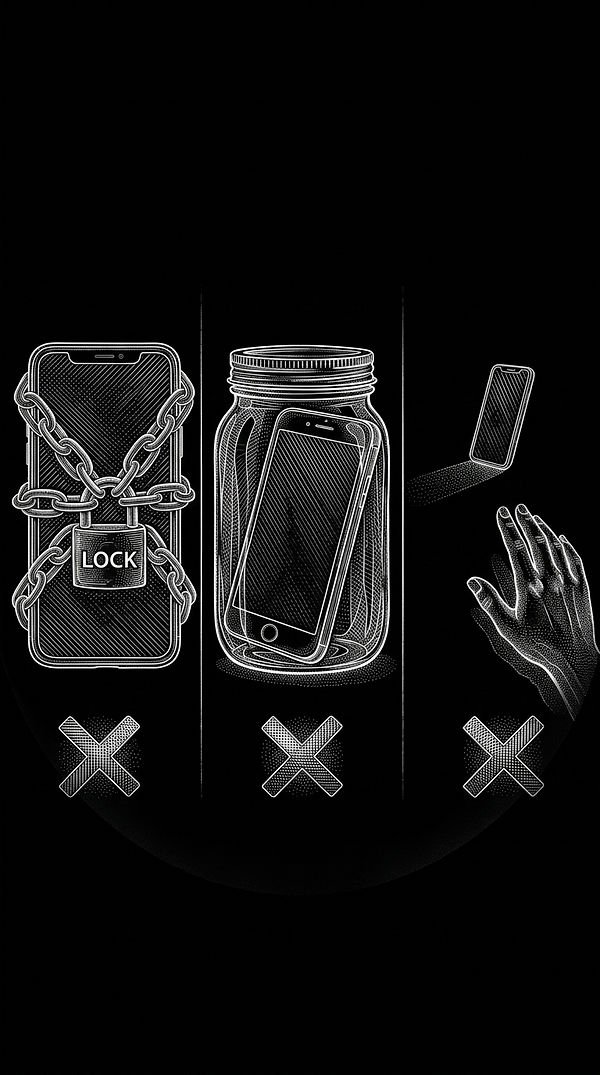
There are also ways to escape commercial algorithms (recommendation systems).
Block. Limit. Keep your distance.
Those are also valid ways of relating to the digital world.
HAKONE chose another approach: adding a “stop action” to the user’s own fingertip.
It is a way of teaching the half-cyborg finger how to stop.
You can experience it on this website.
For the “fingertip that scrolls without thinking,”
a new choice: “Stop here.”
You can experience it on this website.
[ A Message from the Representative, Hosokawa ]
---
Our lives today are filled with countless recommendation systems operating on a global scale.
At HAKONE, we view this digital environment not merely as a collection of technologies, but as a "new arena of life"—a space where we must learn how to exist as human beings.
Our fingertips serve as a constant point of contact with the massive tech companies on the other side of the screen and the recommendation algorithms running across the globe.
We may not be full-fledged cyborgs, but we already exist in a state akin to being "half-cyborg."
The goal is to reclaim these half-cyborg fingertips for the human side. The movement of the fingertips is driven by the normal functioning of the brain's basal ganglia. To reclaim our humanity means teaching new habits to this part of the brain.
The next video.
The next post.
The next recommendation.
Before we realize it, our fingers are moving before we even think. While this is a normal physiological response, it is also a source of human distress. The crucial point is that, because it is a normal function, it cannot simply be "cured." Commercial algorithms are specifically targeting this very reaction.
At HAKONE, we deliberately refer to these modern fingertips as:
"Half-cyborg fingertips."
In the past, fingertips were tools for manipulating physical objects.
Today, those same fingertips touch digital screens countless times throughout the day.
They are the front line where humans and commercial algorithms meet.
Where exactly do humans and algorithms intersect? It is at the "fingertips."
If so, the fingertips may well be the first place where we should rethink "control" from the human perspective.
HAKONE’s concept was born from this very idea: "We can choose to change how we behave."
We cannot rewrite the commercial recommendation algorithms themselves. However, there is still room for us to choose how we act in response to them. HAKONE positions the fingertips as the "final line of defense" on the human side.
The goal is to use this point as a starting point to halt finger habits ingrained in the brain's basal ganglia—and thereby gain the freedom to make one's own choices.
HAKONE aims to restore that right of choice to the user.

HAKONE does not guarantee a reduction in screen time. Instead, it is a service designed to help you choose when to stop, and to experiment with and put into practice the actions needed to do so.
It does not bring about magical, instant change; it requires daily practice.
Through this practice, we reclaim the ability to control our own actions—an ability we once possessed.
We believe there is a need for services that protect human agency in the digital age, and that is precisely the role HAKONE plays.
Our goal is to help you regain control over the usage habits that begin at your fingertips.
We have naturally learned how to enjoy digital content.
But have we had sufficient opportunity to learn how to close the screen of our own volition once that enjoyment ends?
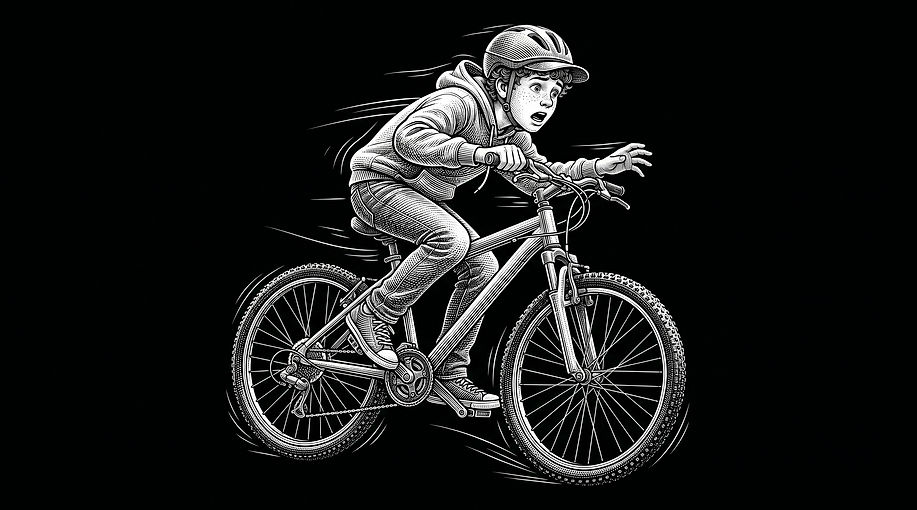
To use a bicycle analogy: we learned how to ride.
However, we haven't practiced enough on how to apply the brakes, put down the kickstand, and bring the day's ride to a close.
Our brain's basal ganglia have never been taught this procedure. In short, we aim to teach the basal ganglia how to stop—just like learning how to stop that bicycle.
Most people seem to understand what HAKONE is trying to achieve based on the explanation I just gave.
HAKONE focuses precisely on that "gap."
Some people keep staring at their screens late into the night because they want to stay connected with others.
Others open the next post to fill an emotional void caused by boredom, loneliness, or anxiety.
There isn't just one reason why we turn to our screens; they all stem from natural human motivations.
HAKONE does not view those motivations themselves as the problem. What we focus on is the moment usage continues even after we’ve decided to stop. The digital environments we inhabit are designed to minimize the "friction" involved in moving to the next piece of content. We simply teach the basal ganglia—which find the act of pedaling so enjoyable—how to stop the bicycle.
The next video.
The next post.
The ceaseless flow of the timeline. Features such as infinite scrolling, autoplay, and recommendation algorithms create an environment that makes it easy for users to move on to the next piece of content.
HAKONE is not the only entity concerned about these structural issues.
A 2024 staff report by the U.S. Federal Trade Commission (FTC), titled *A Look Behind the Screens*, revealed that many of the companies studied analyzed user engagement and leveraged it to keep users within their own content and services. The report also noted that for companies reliant on targeted advertising revenue, there is a financial incentive to prioritize content that boosts engagement, as increased engagement leads to longer usage times and higher ad revenue.[1]

Humans have an innate desire to connect with others, alleviate boredom, and discover new information.
Meanwhile, digital services employ mechanisms that present the next piece of content based on a user's interests and past reactions.
When these two factors combine, users may find themselves continuing to use a service even after they have decided to stop.
This issue cannot simply be dismissed as a matter of "weak willpower."
In a digital environment designed for seamless transitions to the next piece of content, people have learned how to "ride" the platform but have not sufficiently practiced how to "stop on their own."
To use a bicycle analogy, what Mr. Hakone advocates is "practicing how to put down the kickstand"—training the basal ganglia of the brain to execute the action of pausing.
This is a completely new approach.
That said, there is no need to throw away the bicycle itself. Nor is there any need to discard your smartphone.
Smartphones have become an integral part of our lives.
Recommendation algorithms, too, are here to stay.
What we need now is not a way to escape the digital world, but the ability to use it when we want and step away of our own volition when we choose. Since the brain's basal ganglia are simply responding naturally, we need to teach them a different way of operating.
In short, it is about acquiring the skill of "putting down the kickstand"—choosing for yourself when to pause. In other words, it means sending a signal to your fingertips to stop moving, thereby awakening your rational mind. This is how you break free from the cycle of unconscious, automatic scrolling.
Coexisting with technology while firmly maintaining human agency—
that is the "digital autonomy" HAKONE strives to achieve.
So, where can we find this "kickstand" in the digital world?
It lies in your fingertips—the very point of contact between you and the screen. Your fingertips have learned the pleasurable habit of scrolling, a response ingrained in your basal ganglia. Since this is a natural reaction, the goal is simply to teach your basal ganglia a different way of doing things.
Pausing your movement and stopping your fingertips.
That small action creates a moment of choice: "Do I continue, or do I stop here?"
HAKONE is a digital wellness service designed to empower you to decide for yourself how much time you spend with your screen and when to step away from it.
Technology has evolved.
Now is the time for us to evolve the way we use it.
The times demand our evolution.
Will humanity remain glued to the screen, or will we evolve? The choice is yours.
Not "treatment," but "teaching a different way to use your fingers."
What we propose is not "treatment" in the medical sense.
What we propose is "teaching a different way to use your fingers." It is about redesigning our relationship with technology from the perspective of digital engineering.
It means confronting the changes brought about by the digital world using digital means.
Coexisting with technology is no longer merely a passing lifestyle trend.
We now face a new challenge of adaptation: how to maintain human agency within a digital civilization.
There are two possible futures: one where we fail to evolve, and one where we do. Humanity is currently compelled to make that choice.
Evolution begins at the fingertips. Tens of thousands of years ago, when humans began using their fingertips to manipulate tools, our evolution took a giant leap forward.
If that is the case, then for us—now effectively "semi-cyborgs"—the evolution required to reclaim our humanity must also begin at our fingertips.
HAKONE focuses on the very place where the human and digital worlds intersect: the fingertips. By rethinking how we use our fingertips, we propose a new way of acting—one that allows us to choose for ourselves whether to "connect" or "disconnect" within today's digital society.
Throughout history, humanity has adapted to environments ranging from the natural world to urban landscapes.
Today, we live in a digital environment where recommendation algorithms are constantly at work.
Beyond the nature of forests, rivers, and oceans, we now find ourselves in a "second nature"—a vast wilderness of algorithms.
HAKONE views this environment metaphorically as
"a second nature defined by algorithms."
Living authentically within this digitally created "second nature"—that is the next stage of human evolution.
It is an inevitable step in the natural order of things.
We are now in the process of adapting to this "second nature."
It is not about abandoning technology.
It is about evolving the way we, as human beings, engage with this new environment. This evolution of humanity and the digital realm begins at our fingertips.
I believe that this "second nature" will ultimately lead us to a higher plane of existence. Let us embrace and enjoy this world, rather than fear it.
After all, we are witnesses to an era of ongoing evolution.
*The "evolution" referred to here does not denote biological or medical physical changes. Instead, it reflects HAKONE’s philosophy regarding how humans evolve the ways in which they operate and interact with technology as it advances.
Reference
[1] Federal Trade Commission. A Look Behind the Screens: Examining the Data Practices of Social Media and Video Streaming Services. An FTC Staff Report, September 2024, especially pp. 36, 61–74.
01 // THIS IS NOT A DETOX
This is not about throwing away your smartphone.
Your work lives within your smartphone.
Your creative projects.
Your learning.
Your connections.
The tools you need to step out into the world.
The problem isn't the smartphone itself.
It is the design that keeps you trapped on the screen—luring you from one video to the next notification, then on to the next post—long after you’ve finished your original task.
HAKONE doesn’t take your phone away.
It doesn’t let others manage your screen time.
Use it when you need to, and step away of your own volition when you’re done.
We put that control back in your hands—right at your fingertips.
Smartphone devices are weapons.
The device is not your master.

02 // THE EXIT PROBLEM
What was lacking was not the will.
It was an "exit."
Infinite scrolling offers no natural stopping points.
Autoplay features do not wait for you to be ready to watch the next video.
Notifications arrive without regard for your schedule.
Feeds of recommended content have no idea what you originally intended to do.
You do not have to face this situation relying solely on willpower.
If the systems you interact with are designed to manipulate your behavior, then you need a "design" of your own to protect yourself.
HAKONE is not about building a wall of prohibition.
It serves as a quick "exit" between the surging digital torrent and your real life.
This exit works by teaching your brain's basal ganglia—which govern habitual actions—the practice of stopping the scroll. That is the key to the exit.
Do not rely on a fragile "will."
Implant a physical "termination code" into your finger.

03 // DIGITAL AIRLOCK
Try interrupting that flow for just 60 seconds.
It will come as a shock to the basal ganglia of your brain.
Digital Airlock is a digital wellness experience that soothes both mind and body in moments, simply by gently resting your fingertip on a single point on the screen.
It does not intrude, take anything away, or preach to you.
It simply pauses the constant movement of your fingers.
As you listen to the tones of the *suikin* (water harp), you gently shift your awareness—previously glued to the screen—back to your fingertip in the here and now.
That is all there is to it.
HAKONE does not read your mind, diagnose your brain state, or determine the course of your life.
From start to finish, everything remains entirely under your control.
04 // AFTER THE EXIT
What happens after you close the screen—that’s when the real work begins for you.
The moment you put down your smartphone, you are struck by a sensation of a gaping void.
Boredom.
Loneliness.
A stretch of time where you simply don't know what to do.
That is where most digital detoxes come to an end.
They merely urge you to stop looking at your phone, without offering a concrete plan for how to spend the time you have reclaimed.
HAKONE does not leave you with that empty void.
We offer not only a way to step away from your smartphone but also a fresh beginning.
An exit alone is not enough.
Beyond the exit, a destination is needed.

05 // REAL-WORLD MISSIONS
Draw. Learn. Move. Connect.
Beyond the screen lies a world that algorithms did not choose.
There, you will find no instant gratification.
Nothing is measured in numbers.
There is no guarantee of going viral.
Yet, every time you take a step forward on your own, something tangible remains in the real world.
CREATE // Create
Moving from the side that simply gazes at the works of others to the side that draws its own lines.
Drawing a picture.
Writing a text.
Cooking a meal.
Playing music.
Using your hands to bring into existence something that did not exist before.
LEARN // Learn
Professional certifications, language skills, work-related expertise, and the books you’ve wanted to read.
Turn the time spent scrolling through others' successes into time spent building your own capabilities.
MOVE // Move
Walk.
Stretch.
Strengthen.
Breathe the fresh air.
Move your actual, physical body—not an avatar on a screen.
CONNECT // Connect
Talk to people without the mediation of notifications.
Sit in the same place.
Write a letter.
Listen to the voice of the person right in front of you—all the way to the end.
This is not a list for killing time.
It is a list of missions for returning to reality.
06 // CONSUMER → CREATOR
Turn time spent consuming
into time spent creating.
Your timeline is a constant stream of other people’s work, successes, and lives.
Yet, while you watch it all unfold, your own story stands still.
HAKONE isn’t aiming for people who don’t use smartphones.
We aim for those who choose when to connect and when to disconnect—creating something new from the time they reclaim.
Those who once only watched begin to create.
Those who once only knew begin to learn.
Those who once only observed the lives of others begin to set their own lives in motion.
From consumer
to creator.

07 // LEARNING BAY
Once you understand, close the screen.
Tatoemon isn’t an AI that keeps you tied up in long, drawn-out conversations.
It transforms complex terms and concepts into intuitive, easy-to-grasp analogies.
Whether you are studying for a certification exam,
learning about work-related knowledge or new technologies,
or grappling with a topic that has left you completely stuck—
Tatoemon distills the key points and suggests concrete, real-world actions you can take next.
Once the explanation is complete, Tatoemon’s job is done.
Don't live in a custom-made qualification learning app.
Get a grip and face reality.
Leave immediately.
08 // CREATOR BAY
Don't just consume what you see.
Leave your own mark.
HAKONE Art Reflection is not a tool for diagnosing your psychology based on your drawings.
It is a place where a real person truly looks at the work you have created.
The lines.
The colors.
The composition.
The ideas.
The act of seeing the piece through to completion.
We identify what is actually present in your work and respond with words and a video.
It is not about the number of "likes."
It is not a short, automatically generated reaction.
It is the experience of knowing that someone took the time to look at something you created.
Do not draw to be evaluated.
Draw to bring into this world
something that did not exist before.
09 // HAKONE WELLNESS CODE
Humans are the masters.
AI is a tool.
We do not reject technology.
AI, smartphones, and the internet are powerful tools that expand human capabilities.
However, the relationship flips when those tools begin to dictate human objectives.
The HAKONE Wellness Code is a set of design principles ensuring that humans retain ultimate control, no matter how advanced the AI becomes.
You don't need to become someone whom AI won't reject. It is enough to be someone who doesn't lose themselves while using AI.
10 // RETURN TO REALITY
Don't live within the system known as HAKONE.
HAKONE isn’t an app designed to keep you trapped inside.
Once it hands you the gear you need, it sends you out beyond the screen.
Open a book.
Pick up a pencil.
Put on your shoes.
Talk to someone.
Get moving on that work you’d put on hold.
Your life isn’t here.
It’s waiting for the rest of the story to unfold—out there, beyond the screen.
11 // Urgent Proposal: Policy Vacuum – Report from the Chief Researcher
THE FEAR OF YOUNG ADULTS BEING LEFT EXPOSED TO COMMERCIAL ALGORITHMS
In the EU and some other regions, efforts are already underway to require large online platforms to assess risks, reconsider potentially addictive design practices, and improve tools that help users manage the time they spend online.
Yet we see a serious policy vacuum.
Compared with the protections designed for minors, practical support that adults can use in everyday life after turning 18 remains far less systematically developed. Once users reach adulthood, much of the responsibility for navigating enormous commercial digital systems is placed back on the individual.
Tonight, there are still young adults lying in bed, unable to stop an endless scroll.
At this very moment, what can help them stop the movement of their finger and move on to the next action?
Practical support that reaches the adult user at the level of that concrete exit action remains limited.
UNDERSTANDING THE SYSTEM DOES NOT ALWAYS MAKE IT EASY TO STOP
Digital Independence in the Transition to Adulthood
The ability to end an endless scroll by choice does not suddenly become complete on the day a person turns 18.
HAKONE is primarily designed for people who already recognize that recommendation systems and engagement-oriented design may be extending the time they spend on digital platforms.
They understand the structure.
And yet, they may still find it difficult to stop at the point they themselves intended.
HAKONE is designed for users aged 18 and over who feel frustration—even a sense of humiliation—at this gap between understanding what is happening and being unable to end the interaction when they choose, and who believe that the human side also needs practical tools.
For many young adults, the smartphone is essential infrastructure for social life: communication, education, work, payments, information gathering, and much more.
For that reason, approaches developed for minors—such as taking away the device or placing its use under parental control—are not sufficient as adult support.
Adults need a way to continue using the smartphone as a tool for modern life while also being able to choose for themselves when to connect and when to stop.
The problem is that digital technology has advanced faster than the skills and practical support that help adults choose their own moments of connection and disconnection.
We see this as a serious social gap in adult digital independence.
HAKONE — PRACTICAL SUPPORT ADULTS CAN USE TODAY
While public policy works on institutions and platforms, HAKONE focuses on practical support that users aged 18 and over can try for themselves today.
The two approaches are not competitors. They serve different roles.
HAKONE is not a substitute for law.
HAKONE is not a substitute for medicine.
A defining feature of HAKONE is that it does not treat the short interruption of screen use as the end of the process.
It also addresses what comes next: how the time created after leaving the screen can be redirected toward learning, creating, working, physical activity, and real-world human relationships.
These elements are treated as one continuous support design.
Let us change a present in which commercial algorithms are consuming the time that makes up our lives.
THE RETURN ALGORITHM
A HAKONE Concept
When a person steps away from endless scrolling, an empty space can appear where the screen had previously been filling time.
That moment is more important than it may seem.
Endless scrolling continually supplies the next piece of content while the user remains inside the screen, making it easy for the interaction to continue.
But the design of commercial platforms does not necessarily end when the user closes the screen.
Systems can also exist to encourage users who have left to return.
HAKONE uses the term Return Algorithm as an umbrella concept for digital design mechanisms that, depending on the service, may use observable behavioral data—such as viewing history, interaction history, time spent, or patterns of return—and combine them with notifications, unread indicators, app-icon badges, re-entry pathways, personalized home screens, or recommendation displays in ways that can encourage return visits and re-engagement.
The Return Algorithm is not the name of a single, universally established algorithm.
It is HAKONE's own design term for describing a structure in which multiple features and operational mechanisms may work together.
It does not claim that every service uses the same data, the same functions, or the same objectives.
THE SYSTEM DOES NOT NEED TO READ YOUR EMPTINESS
The Return Algorithm does not necessarily read a user's sense of emptiness or loneliness directly.
It does not need access to a person's inner emotional state for a return pathway to work.
On the human side, there may remain an expectation formed through previous experience:
“If I open it, stimulation will be there immediately.”
On the system side, behavioral data may remain about what that person previously watched for longer periods or what they reacted to.
Then an empty moment or boredom appears.
The app icon is still in the location the finger remembers.
Unread indicators and notifications remain available as entrances back into the service.
Depending on the platform, content that the user may be likely to engage with can also appear through notifications or after re-entry, based in part on previous behavioral history.
When the expectation remaining on the human side meets the history remaining on the system side at that point of re-entry, a person may return to the screen through habitual action before fully stopping to consider whether that is what they actually want to do.
WHAT HAPPENS AFTER YOU STOP THE ENDLESS SCROLL?
HAKONE organizes this structure in the following way.
Features such as endless scrolling, autoplay, and continuous recommendation can support continued use within a single session while the user remains on the screen.
By contrast, the group of mechanisms HAKONE calls the Return Algorithm may work in the direction of encouraging return between sessions, after the user has already closed the screen.
Because pathways back into the service remain after the screen is closed, stopping can become less like a final endpoint and more like a pause before the next return.
In such an environment, some people may find it difficult to maintain the digital habits they want if their strategy relies only on willpower.
That is why two things need to be designed together:
an exit action that interrupts endless scrolling,
and a real-world destination to move toward after the interruption.
HAKONE's Digital Airlock creates a brief interruption point in screen interaction.
HAKONE then provides REAL WORLD MISSIONS as the next stage of support, creating pathways that help users move the time after closing the screen toward learning, creativity, work, physical activity, and real-world human relationships.
The purpose is to make it easier for the user to choose what they will do next in the real world.
If the Return Algorithm creates pathways that can reconnect a user to the screen they previously left, HAKONE creates another pathway:
a pathway for the user to reconnect, by their own choice, with reality.
While policy works to change the environment from the side of institutions and platforms, HAKONE provides people aged 18 and over with an exit action they can try right now—and a real-world destination to move toward afterward.
The goal is not simply to stop the screen once.
The real question is:
After interrupting the endless scroll, how do you live next?
That is why HAKONE exists as practical support for users aged 18 and over.
[ DEFINITION NOTE ]
Return Algorithm is a proprietary umbrella term used by HAKONE to describe multiple features and operational mechanisms that may support return visits and reconnection within digital services.
It is not a single universally established scientific term, technical standard, medical term, or diagnostic category.
HAKONE does not claim that every platform operates all of the features described above using the same data, objectives, or methods.
DEFINITION NOTE
Note on Definitions
"Re-engagement algorithm" is a term unique to HAKONE that comprehensively refers to various features and operational methods designed to encourage return visits or reconnections within digital services.
It is not a globally established scientific term, technical standard, medical term, or diagnostic label.
This term does not imply that all platforms implement the features described here using identical data, objectives, or methods.
11 // Global Policy and Government Pilot (Gov-Pilot) Proposal
Global Policy Submissions & Gov-Pilot Initiations
I am Tokkyu Hosokawa, a Digital Public Health Auditor and Algorithmic Ethics Designer whose work spans the interdisciplinary fields of law, systems engineering, and biology. For ten years, I have studied digital science based on empirical data gathered from 1,500 families.
As a long-term mission, I have designed HAKONE, an anti-algorithm infrastructure—a practical form of “reverse hacking” intended to help human beings maintain agency while continuing to coexist with the commercial algorithms operated by major digital platforms.
HAKONE is conceived as a Commercial Algorithm Disaster-Prevention System: an infrastructure designed not to eliminate commercial algorithms, but to equip the human side to live alongside them without surrendering control.
Today, governments around the world are advancing discussions on the protection of minors.
Yet a critical policy gap remains:
policies supporting digital independence for adults immediately after the transition at age 18 are largely absent.
I have continued to raise the alarm about this serious policy vacuum.
To address the global challenge of people finding it difficult to disengage from algorithm-driven screens—and to help close this policy gap in the countries listed below—I have submitted formal letters to major government institutions requesting an independent evaluation of HAKONE AI’s Algorithm Defense Architecture through a Gov-Pilot framework.
This infrastructure has been specifically designed to complement national policies in public health, education, and digital well-being by providing a practical defense framework on the user side.
■ Africa
Nigeria: Federal Ministry of Youth Development | Federal Ministry of Health and Social Welfare
Kenya: Ministry of Youth Affairs, Creative Economy and Sports | Ministry of Education
South Africa: Department of Social Development
■ North & Central America
United States: Office of the U.S. Surgeon General | Federal Communications Commission (FCC) | California Department of Education
Canada: Ontario Ministry of Education
Mexico: Secretaría de Educación Pública (SEP)
■ South America
Brazil: Ministério da Educação (MEC)
Colombia: Ministerio de Tecnologías de la Información y las Comunicaciones
Argentina: Ministerio de Capital Humano
Chile: Ministerio de Educación (Mineduc)
Peru: Ministerio de Educación (Minedu)
Ecuador: Ministerio de Educación (MinEduc)
■ Europe
United Kingdom: Ofcom | Department for Education
Spain: Ministerio de Sanidad
France: Ministère de l'Éducation nationale
Germany: Bundesministerium für Gesundheit (BMG)
Italy: Ministero dell'Istruzione e del Merito
Austria: Bundesministerium für Bildung (BMB)
Switzerland: Bundesamt für Gesundheit (BAG)
Belgium: SPF Santé publique
■ Asia & Oceania
Australia: eSafety Commissioner
New Zealand: Ministry of Education
Indonesia: Kementerian Komunikasi dan Digital
Singapore: Ministry of Digital Development and Information
Philippines: Department of Education (DepEd)
Malaysia: Kementerian Pendidikan Malaysia
India: Ministry of Health and Family Welfare
Japan: Ministry of Internal Affairs and Communications | Ministry of Health, Labour and Welfare
Disclaimer
The institutions listed above represent the designated recipients of HAKONE AI Gov-Pilot evaluation proposals.
References to these institutions are provided solely to identify the governmental bodies addressed through our policy outreach initiative.
Such references do not imply any official partnership, endorsement, sponsorship, approval, or current deployment of the HAKONE AI system by any of the government institutions listed above.

12 // We sought international safety standards for the code design.
Safety was not something added afterward.
It was part of the fundamental architecture from the very beginning.
From the earliest stages of development, HAKONE was built around principles such as UNICEF’s Safety by Design and the concept of human support and oversight reflected in WHO guidance.
Many digital products add safety measures after the product itself has already been built.
HAKONE took the opposite approach.
Adult user safety, professional involvement, limits on interactions with AI, human oversight of AI behavior, data minimization, clear boundaries separating the service from medical practice, and escalation from AI to human support were incorporated from the outset as essential design requirements.
These principles have been translated into documented operational procedures, implemented in source code, and supported by repeatable testing.
This is not simply a promise of safety.
Safety itself is part of the architecture.
For that reason, putting rigorous safety principles into actual operation inevitably requires labor-intensive human involvement.
Easy automation that relies primarily on general-purpose AI cannot, by itself, reliably preserve every ethical boundary that this model requires.
Based on that reality, HAKONE made a deliberate decision:
we chose not to pursue the enormous commercial gains that can come from scaling at any cost.
Instead of maximizing efficiency through algorithms, we adopted a haute couture architecture—a fully customized model adapted to each individual user’s digital environment and desired state.
One person. One AI.
An artificial intelligence configured specifically for that individual and tuned to the contours of the commercial algorithmic environment surrounding them.
From the perspective of the modern technology industry, this process might appear to be the ultimate inefficiency.
For us, that is precisely the point.
It is the source of our pride in human craftsmanship.
We should also remember that commercial algorithms themselves are highly personalized to individual users.
In that sense, they are already a form of digital haute couture.
HAKONE’s approach is to meet personalization with personalization:
haute couture against haute couture.
It reflects an almost obsessive commitment to safety.
Human craftsmanship must come first.
The philosophy is comparable to the extraordinary attention to detail found in the craftsmanship associated with Rolls-Royce at Goodwood in the United Kingdom.
For example, the fine line running along the side of certain Rolls-Royce vehicles—the coachline—is traditionally painted by hand by a specialist using a fine brush, relying on human eyes, hands, and craftsmanship rather than ordinary automated application.
Likewise, interior wood veneers are carefully selected, matched, finished, and polished to create the symmetrical grain patterns known as bookmatching.
Processes that industrial automation might perform rapidly are instead entrusted to human hands.
It is precisely this minute variation—and the relentless pursuit of precision—that can transform an industrial object into something closer to a work of craftsmanship.
What we practice at HAKONE follows the same philosophy:
haute couture for human digital independence.
Large digital platforms inevitably provide environments designed to serve enormous populations.
They are, in that sense, closer to prêt-à-porter—ready-to-wear.
HAKONE takes a different path.
We individually take the “measurements” of each user’s relationship with the digital environment: their personal context, their patterns of interaction with technology, and the circumstances of everyday life.
We then define the safety boundaries for that individual, fit them provisionally, and refine the seams of the system by hand.
The result is not mass-produced digital support.
It is digital haute couture built around the human being.

Such overwhelming inefficiency.
Yet, this is precisely the kind of "human work" required to uphold human dignity.
We can never simply offload considerations regarding human ethics and safety onto a system for complete automation or digitization.
By embracing this labor-intensive, hands-on, and gritty work, we resist the tide of efficiency and reclaim "human agency" from algorithms.
Weaving together a system that protects human dignity through entirely individual, manual craftsmanship—this deeply analog and "inefficient" process serves as an absolute bulwark for reclaiming control from massive platforms.
That is the design philosophy behind Wellness Code HAKONE’s handcrafted, "haute couture" approach.
It is the reason we embedded these principles—such as UNICEF’s "Safety by Design" and the WHO-aligned principle of "human-in-the-loop" support—directly into our foundational design.