

FROM HOSOKAWA GRACIA TO HAKONE
Carrying the Idea of “Inner Freedom” into the Digital Age
1 | A Story Quietly Passed Down Through My Family
In my family, a story has been quietly passed down through generations: that our family line is connected to Hosokawa Gracia, a woman who lived during Japan’s turbulent Warring States period.
The formal genealogical records that might establish this lineage have been lost over the course of history.
For that reason, I do not present this as an officially verified genealogy.
It is a story preserved within my family—a form of personal and spiritual inheritance.
And for me, what truly matters is not status.
It is not bloodline.
What I want to carry forward is a principle:
No matter how powerful the pressure around us becomes, a human being must not surrender inner freedom.
2 | The Spirit Remained, Even as the Times Changed
Centuries passed.
The age of the samurai came to an end, and one branch of the family connected to the Hosokawa name eventually established roots in Akita, in northern Japan.
Within my own family, that inherited sense of responsibility gradually took another form:
responsibility toward the community.
My grandfather, Seikichi Hosokawa, lived and worked among the people of the Oga region during a period of profound change in Japanese society.
The age of carrying swords was over.
But the responsibility to protect the next generation had not disappeared.
3 | HAKONE Did Not Begin as a Project to Save the World
HAKONE began with one person.
My daughter.
As the amount of time she spent on her smartphone increased, I gradually began to feel uneasy.
A device that had originally been a useful tool seemed increasingly to invite one action after another:
Look one more time.
Touch it one more time.
Scroll one more time.
I did not want to take the smartphone away from my daughter.
I did not want to monitor her.
And I did not want to stop her through punishment or force.
So I began with a different question:
Could I create a way for her to stop by herself?
That question led to the first prototype of HAKONE.
HAKONE did not begin as a grand project to change the world.
It began as a small system created by one father for his daughter.
4 | Then I Realized This Was Not Only My Daughter’s Problem
The more I investigated, the larger the problem became.
Endless scrolling.
Autoplay.
Constant notifications.
Interfaces with almost no natural stopping point.
This was not only my daughter’s problem.
It was not only one family’s problem.
It was not only one country’s problem.
A new era had begun:
young people around the world were growing up inside digital environments that continuously competed for their attention.
From that moment, the meaning of HAKONE changed.
A small prototype created for my daughter became part of a larger mission:
to help protect the freedom of choice of the next generation.
5 | From “Someone Else Controls You” to “You Can Stop Yourself”
My answer was not to control young people more aggressively.
HAKONE is not designed to confiscate smartphones.
It is not designed to monitor behavior.
It is not designed to forcibly disconnect people from the internet.
HAKONE asks a different question:
Can technology itself be designed to include a place to stop?
The interaction is simple.
Place your finger on the screen.
Keep it still.
For just 60 seconds, reverse the relationship you normally have with your smartphone.
Usually, moving your finger requests something new:
another post,
another video,
another piece of information.
With HAKONE, stillness itself becomes the input.
The purpose is not to take the smartphone away.
The purpose is to create one brief moment in which you can stop and ask yourself:
Do I want to continue?
Or do I want to put the phone down here?
And then choose again for yourself.
6 | From the Freedom Gracia Protected to the Freedom We Must Protect Today
Hosokawa Gracia lived in an age of castles, war, and political pressure.
The world inhabited by young people today is completely different.
But pressure on human beings has not disappeared.
Its form has changed.
Today, that pressure may arrive through a screen hundreds of times a day:
Look again.
Open it again.
Scroll again.
Stay a little longer.
Perhaps the freedom we need to protect in the digital age begins with an extremely small action:
the freedom to stop your own finger by your own choice.
For me, this is where the story of Gracia and the story of HAKONE meet.
I do not mean that a history from 400 years ago gives us a technical answer to a modern technological problem.
It does not.
What remains is the question.
Four hundred years ago, and again today:
When powerful forces are acting upon us, can we still make the final choice for ourselves?
7 | The Mission of HAKONE
HAKONE began with my daughter.
But it no longer belongs only to her story.
Today, HAKONE aims to create another option for people living in a digital society where simply stopping has become increasingly difficult:
the option to pause for themselves.
We are not fighting technology.
We are not asking people to develop superhuman willpower.
Instead, we redesign technology from the opposite direction.
If an algorithm can be designed to keep a person moving,
then an interface can also be designed to help a person pause.
That is the mission I believe I have inherited in my own way.
From one family.
From one daughter.
And toward the next generation around the world.
HAKONE
The freedom to stop.
The freedom to choose.
Technology designed to protect the freedom to return to your own time.

4-610 Kurokami, Chuo-ku, Kumamoto City, Kumamoto Prefecture.
My eldest daughter and I in front of the graves of Fujitaka (the first head of the Hosokawa family) and his wife, as well as Tadaoki (the second head) and Lady Gracia. A photo taken during a visit while on vacation.

The Hosokawa family's ancestral temple, located within Tatsuda Nature Park at 4-610 Kurokami, Chuo Ward, Kumamoto City, Kumamoto Prefecture. The site of Taishō-ji Temple. My wife and I.
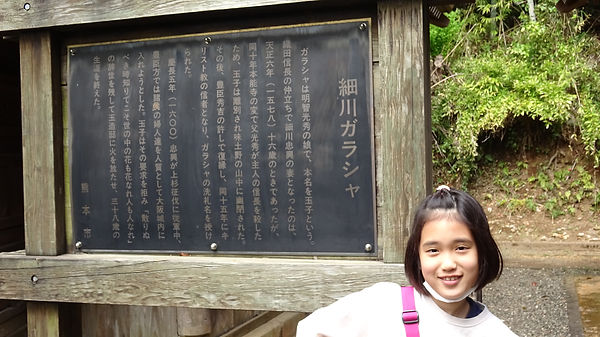
My eldest daughter with the sign for Tatsuda Nature Park (Hosokawa Family Cemetery), a Kumamoto Prefecture-designated historic site.

The mausoleum (grave) of Hosokawa Gracia

1940 – Oga City, Akita Prefecture – Kiyokichi Hosokawa – New Year's commemorative photo

At the grave of Lady Gracia.

This is the current grave of my Hosokawa family. The Hosokawa "Kuyo-mon" (Nine-Star Crest) reflects the family's roots.
Overview: There is a family tradition stating that the lineage of the family progenitor, Hosokawa Tadataka (Nagaoka Tadataka), branched off from Hosokawa Gracia (Hosokawa Tama, 1563–1600) and that his descendants eventually relocated to Yuwa, Akita Prefecture (present-day Akita City). This document outlines the key points of the family lineage—compiled from oral tradition—in a chronological format, while noting the supporting evidence and uncertainties associated with each stage. It is explicitly stated that this information is based on oral tradition, as verification through official family registers, local histories, or other public records has not yet been conducted.
Hosokawa Family Timeline and Genealogical Record
1563
Hosokawa Tama — later known by her Christian name, Gracia
Relationship / Background:
Daughter of Akechi Mitsuhide and wife of Hosokawa Tadaoki.
Details:
Born in Echizen Province, an area that is now part of Fukui Prefecture. She later married Hosokawa Tadaoki, a prominent samurai lord of the Sengoku period. In 1587, she was baptized as a Christian and became known as Gracia.
Sources:
Materials from the National Diet Library of Japan; encyclopedic references.
1580
Hosokawa Tadataka — also known as Nagaoka Tadataka
Relationship / Background:
Eldest son of Hosokawa Tadaoki and Gracia.
Details:
Born on April 27, 1580. He was Gracia’s first child and was initially regarded as the heir to the Hosokawa family. He was not baptized as a Christian.
Sources:
Genealogical materials relating to Hosokawa Gracia.
1600
Death of Gracia and the Disinheritance of Tadataka
Event:
Gracia died in 1600, and later that same year Tadataka was removed from the position of heir.
Details:
On July 17, 1600, Gracia died at the Hosokawa residence in Osaka.
Later that year, Hosokawa Tadaoki ordered Tadataka to divorce his wife, who was a daughter of Maeda Toshiie. Tadataka refused, and as a result he was disinherited.
Sources:
Historical incident records, diaries and related documents concerning events in Osaka.
1646
Nagaoka Tadataka — also known as Kyumu
Relationship / Background:
Founder of the Nagaoka Naizen family line.
Details:
Tadataka died at Koto-in, a sub-temple of Daitoku-ji in Kyoto, at the age of 67. Part of his remains were later associated with Zuigan-ji in Kumamoto.
Although he had been formally disinherited, he continued to retain an important position within the broader Hosokawa family tradition and spent the rest of his life in Kyoto.
Sources:
Biographical records and historical reference materials.
Edo Period
Descendants of Nagaoka Tadataka — the Hosokawa Naizen Family
Relationship / Background:
Retainers of the Hosokawa family of the Kumamoto Domain.
Details:
Descendants of Tadataka, including later generations of his family line, served the Kumamoto Domain and continued the lineage known as the Hosokawa Naizen family.
Memorial tablets and graves connected with the family are said to remain in Kumamoto.
The family is believed to have continued living in Kumamoto until around the Meiji Restoration. Their later movements are not yet fully known and require further confirmation through family records and local historical materials.
Sources:
Materials held by the Eisei Bunko Museum and related historical records.
Around 1887 — Estimated
Hosokawa Seikichi
Relationship / Background:
Family tradition identifies him as a direct descendant of the Tadataka line.
Details:
The estimated year of birth is based on a family account stating that Seikichi was 53 years old in 1940.
Public records confirming his date of birth have not yet been identified.
Further verification through family registers, household records, and other official documents remains necessary.
Sources:
Family oral history, including testimony concerning his age.
1898
Hosokawa Seikichi and Tobei
Relationship / Background:
Recorded in documents connected with Maeyachi Village, Miyagi Prefecture.
Details:
A New Year’s greeting dated January 1, 1898, survives bearing the names Hosokawa Seikichi and Tobei, addressed to Saito Zenemon of Maeyachi Village in Miyagi Prefecture.
This document is an important record indicating the family’s whereabouts before the later move to Akita.
Sources:
Saito Documents, Tohoku University.
1938
Hosokawa Kiyonori
Relationship / Background:
Youngest child of Hosokawa Seikichi.
Details:
Family records state that Kiyonori was born as the youngest of seven siblings in the family of Hosokawa Seikichi.
Sources:
Family records and oral tradition.
1940
Hosokawa Seikichi — recorded as age 53
Details:
According to family oral tradition, Seikichi was recorded as being 53 years old in 1940.
If this account is accurate, his birth year would have been approximately 1886 or 1887.
Sources:
Family oral tradition.
Showa Period — Exact Date Unknown
Migration of the Hosokawa Seikichi Family to Yuwa, Akita Prefecture
Relationship / Background:
Family tradition states that distant relatives may also have been involved in the migration.
Details:
The exact date when the family moved to Yuwa Village, now part of the Yuwa area of Akita City, has not yet been confirmed.
Family tradition also contains references to migration connected with areas such as the Osarizawa Mine.
However, the Hosokawa family name has not yet been confirmed in the local history History of Yuwa.
Further research through family registers, land records, and materials held by the Akita City Archives may be necessary.
Sources:
Family oral tradition and historical materials from Akita Prefecture.
1968
Tokkyu Hosokawa
Relationship / Background:
Eldest son of Kiyonori Hosokawa and Kazue Hosokawa.
Details:
Born in 1968 as the eldest son of Hosokawa Kiyonori and his wife, Kazue.
Sources:
Family records and oral tradition.
# A Note on the Historical Status of This Genealogical Record
This document presents the history of our family as it has been passed down through generations, tracing its tradition to **Hosokawa Gracia (Tama)**, and through her eldest son, **Hosokawa Tadataka **, to the lineage associated with the Hosokawa Naizen family.
As we make this record available to those with a deep interest in history and faith, including members of the Vatican community, we believe it is important to explain clearly how this genealogy should be understood.
At present, this family lineage has **not been officially recognized or certified as a formal genealogy by the main Hosokawa family or by any public authority**.
Historical records were lost or dispersed during periods of upheaval between the Edo period and the early Meiji era, leaving gaps in several generations for which we must rely, at least in part, on oral traditions handed down within the family.
For this reason, this document should be understood as containing elements of an **unofficial family record**, rather than as a fully verified institutional genealogy.
We do not, however, believe that these gaps should simply be dismissed by saying that “the details are unknown.”
The history passed down within our family—sometimes by only the thinnest thread of oral memory—eventually encountered an important piece of documentary evidence connecting that family memory to the historical record.
That evidence is found in the **Saito Documents held by Tohoku University**.
Among those materials is a New Year’s greeting dated **January 1, 1898**, bearing the names **Hosokawa Seikichi and Tobei**, associated with Maeyachi Village in Miyagi Prefecture.
For many years, Hosokawa Seikichi had existed for us primarily within the oral history of our family.
The discovery of his name in historical materials preserved by a major Japanese academic institution provided an important documentary anchor for that family tradition.
This single document establishes historical evidence for the presence of our ancestor Hosokawa Seikichi before the family’s later migration to Akita.
For us, it also represents an important point at which inherited family memory and surviving documentary history meet.
It does **not, by itself, constitute documentary proof of every generation extending back to the time of Gracia**. The intervening lineage remains an area in which further historical and genealogical research is necessary.
Nevertheless, the Saito Documents give tangible historical support to a part of a story that had long survived primarily through family memory.
For our family, this discovery was like recovering a missing piece of a much larger historical puzzle.
The story extending from the age of Gracia through the generations that followed—and into the Showa, Heisei, and Reiwa eras—therefore contains both **documented history and inherited family tradition**.
We present the two honestly, without confusing one for the other.
We take seriously the evidence left behind by those who came before us, and it is with humility and pride that we make this family record public.
We hope it may be received as the record of one family that carried its memory, faith, and life through generations of profound historical change.
Tokkyu Hosokawa

Tohoku University is a highly prestigious national comprehensive research university founded in 1907, with its headquarters in Sendai City, Miyagi Prefecture. It is one of Japan's seven former Imperial Universities and was among the first three institutions—alongside the University of Tokyo and Kyoto University—to be designated as a "Designated National University Corporation," a status recognizing institutions expected to achieve world-class standards in education and research. Furthermore, it has been certified as the first "Universities for International Research Excellence" in Japan—a new designation established by the Japanese government—and enjoys an exceptionally high reputation both domestically and internationally.