
The journey of Hosokawa—a practitioner who dives headfirst into the field, driven by an extraordinary and relentless spirit of inquiry.
[The Electronic Sounds That Saved Me from the Brink of Despair]
When I was in junior high school, I was subjected to severe bullying and seriously contemplated taking my own life. What caused me to "postpone" that decision was a televised concert by YMO (Yellow Magic Orchestra). I felt I simply couldn't die before seeing that broadcast. From the day I stepped back from the edge of despair, my life diverged from the conventional framework of schooling, and I stopped attending classes.
Yet, that time was by no means wasted. I became deeply fascinated by fields that had not yet permeated mainstream society in 1980—computers, synthesizers, and digital technology—and immersed myself in exploring them through self-study. I spent my days assembling homemade radios and cassette decks, and crafting battery-operated analog electronic devices. Instead of going to school, I dedicated myself to exploring a world of my own creation built from electronic components.
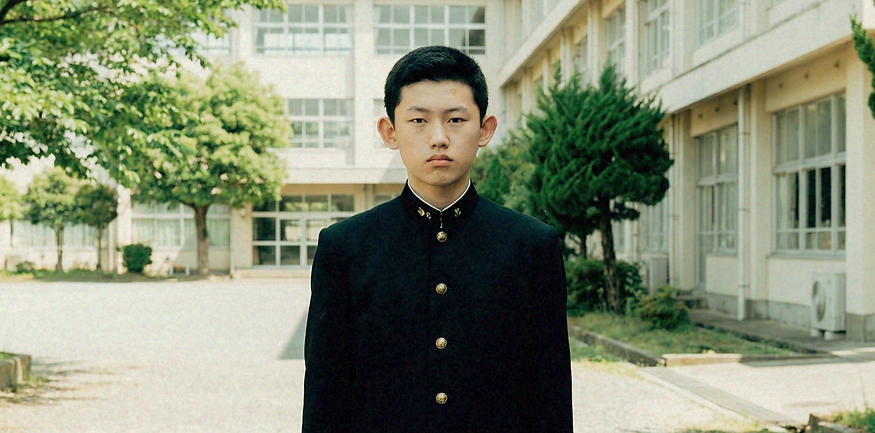
Me in junior high school
[The Barriers of a Credential-Obsessed Society and a Life-Changing Encounter]
I entered the workforce without formal educational credentials, initially working as a sewer pipe installer. There, I confronted the harsh reality of a society that places immense value on academic background; without the proper qualifications or education, I could not pursue the career I truly desired.
During this period of stagnation in my life, I met a woman at the gym. She was a swimming coach who also held an elementary school teaching license—and she would later become my wife. To make up for the education I had missed out on, she dedicated time every day to teaching me from the very basics. Our combined efforts paid off, and I eventually obtained a qualification in real estate transactions. My skills were recognized, leading to an opportunity to gain practical experience at a law firm.

Me during my time as a sewer pipefitter
[Connecting the Dots: A Lesson in How Misfortune Can Turn into Fortune]
Subsequently, the era of Windows 95 dawned. I managed to land a job at a systems company just as the industry was in its infancy—a time when there was a demand for a diverse range of talent.
It was here that my past experiences proved invaluable in a dramatic way. The time I had spent confined to my room during my period of school non-attendance—quietly tinkering with electronic components and building analog devices—had laid a solid foundation in electronics engineering. My ability to read and draft schematics for electronic equipment was undoubtedly a gift born of those days away from school. The time I spent unable to attend classes turned out to be the greatest asset supporting my future self. That was the moment I truly grasped the profound truth that life’s misfortunes can unexpectedly lead to good fortune.

システム会社時代の私
[Not a Failure, but a Necessary Process—Giving Back to the Next Generation]
When I reflect deeply on my journey, I have come to a firm conviction: the time I spent unable to attend school and off the conventional societal track, and the days I lived crawling along the ground, covered in mud as a plumber—none of these were "failures." They were an unavoidable and essential "process" for me to take control of my own life.
Later, driven to explore the theme of "tuna and human emotions" firsthand, I left my research position and decided to head out onto the open ocean as a crew member on a deep-sea tuna fishing vessel. Life on the raging seas was beyond imagination, yet the reason I was able to endure such grueling labor was precisely because I possessed the rugged physique of a plumber—forged in the muddy waters of the sewer system. Those gritty experiences from my past sustained my very life.
However, reality is not so forgiving that passion alone can pave the way to success. Although I finally established the research institute I had long dreamed of, my funds ran completely dry within just a few months. I fell behind on rent and received no government support whatsoever. I was at a total dead end, utterly at a loss.
Yet, the memory of the "me" from those days—covered in mud—spurred me to action. I partitioned the institute's space and opened a "specialized cafeteria for Metropolitan Police Department personnel" alongside it—a desperate, last-ditch strategy.
How could I protect the minds and bodies of these individuals who faced extreme tension and grueling working conditions? The answer was "tuna." Rich in nutrients and high-quality protein, tuna serves as the ultimate source of energy to repair the brains and bodies of those fighting on the front lines, helping to stabilize their emotions.
The entire trajectory of my journey—crawling through the mud, crossing the seas, and walking the very edge of despair. I believe that this very process—clumsy and inefficient as it is—is the "hope" that should be conveyed to the young people currently struggling in the darkness.


Me during my time as a tuna crew member
[Bringing Voiceless Voices to the World: The Mission of Digital Public Health Auditing]
Driven by my own arduous journey and the conviction that "taking the long way around is never a waste," I established a space in 2014 where young people could experience ways of living that transcended the conventional "freeter" (casual part-time worker) label. It was a place that offered genuine connections to the real world through hands-on experience for young people who had stepped off the established tracks of school and society and were feeling lost or at a dead end.
From this grassroots activity emerged another major challenge—one that leads directly to my current work. With the cooperation of the young people gathering at the facility and the families supporting them, I launched a decade-long research and development project rooted in "citizen science." I listened to the heartfelt voices of those suffering from school refusal, family conflict, and the mental exhaustion caused by rapid digitalization, treating their stories as invaluable empirical data that could not—and must not—be ignored.
The tears they shed and the days they fought in solitude must not be dismissed as merely a matter of "individual responsibility." It is precisely this sense of righteous indignation and mission that lies at the heart of my work as a "Digital Public Health Auditor."
Today, I leverage the heartfelt voices and data I have painstakingly gathered and woven together over the past decade as solid evidence to make policy recommendations to government agencies worldwide. My goal is to protect people's minds from the algorithms of massive digital platforms.
That small step taken "on the ground" alongside lost and hurting young people has now crossed oceans, expanding into a powerful movement poised to reshape the rules of our global digital society.

Part-time worker experience facility: Shaking hands with young people

"Freeter" Experience Facility: Young People Trying Out Jobs
[To the Young People Shaping the Future]
My insatiable spirit of inquiry is now directed toward helping young people around the world who are struggling with the adverse effects of digital civilization.
Just as I once immersed myself in the world of analog electronics, today’s youth are at risk of being swallowed by a vast ocean of commercial algorithms. Yet, our goal is not to abandon technology. Rather, I wish to share a path—one of "upgrading civilization"—with young people and government bodies globally; a path where we learn to coexist with commercial algorithms and master the art of utilizing them effectively.
Young people currently suffering from the negative aspects of the digital world—that sensation of having their time stolen—will eventually realize a profound truth as they move into the future: that the very period of their greatest struggle was, in fact, a pivotal turning point in their lives. It is much like how my own experience of dropping out of school served as an essential step in shaping the system architect and algorithm ethics designer I am today.
I will continue to join hands with young people, dedicating myself to the forefront of the pursuit of a "real life"—one that preserves our humanity even as we coexist with the artificial intelligence and digital technologies of the future.
